Real Implementation Value from AI in Professional Services
Discover how AI is transforming professional services through agentic workflows, smarter resource planning, stronger margins, and governed automation.

What's in the article:
Professional services firms are past the “should we try AI?” stage: 44% are switching PSA solutions, and 69% are changing ERP systems specifically for embedded AI (IDC, 2025). The data is clear. Here’s what it tells us about real implementation value:
The firms seeing results aren’t the ones moving fastest. They’re the ones moving deliberately—with clear metrics, realistic expectations, and governance that makes every autonomous action traceable.
Professional services firms do not need another abstract conversation about AI. They need to know what changes when AI meets project delivery, resource planning, financial operations, and client work.
That gap between what AI is supposed to deliver and what it actually changes in the work is frustrating. And frankly, it’s a fair frustration. A lot of what gets written about AI in professional services focuses on the technology itself rather than the operating reality inside project-based firms.
This article takes a different approach. It looks at real implementation data, practical examples of how firms are using AI today, and the places where human judgment still has to lead. The goal is simple: understand what changes in the business, what needs to be governed, and where firms need to be careful before they automate.
The numbers tell a clear story. IDC reports that 48% of organizations plan to invest in AI-powered PSA applications, 44% plan to invest in AI-powered ERP applications, and 22% would replace their current PSA or ERP applications if GenAI is not included in the next release (IDC, 2025).
The switching trend is especially important. Just over 44% of firms are switching PSA solutions, and 69% are switching ERP systems. They are not just looking for a better interface or more reports. They are changing systems specifically to gain embedded AI for intelligent workflows, speed, scale, and agility. These are not pilot programs. Firms are replacing their core operational systems based on AI capabilities. That’s a significant commitment.
To understand what’s driving this shift, it helps to understand what firms are switching from—and why PSA mattered in the first place.
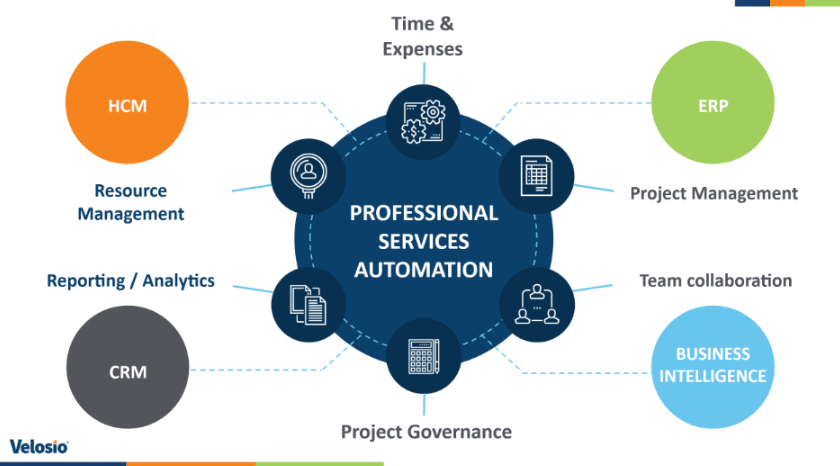
Professional Services Automation (PSA) software integrates project management, resource management, project accounting, budget management, time and expense tracking, and reporting into a cohesive single application. Firms adopted PSA primarily to optimize workforce utilization and manage project-based operations more efficiently.
And PSA solved real problems. Before these systems, firms were constantly wrestling with fundamental visibility and data silos:
PSA addressed those questions. It gave firms resource visibility, scenario planning for staffing decisions, and integrated data across ERP and CRM systems. So why switch now?
The answer isn’t about adding more features. AI changes the fundamental operating model. Traditional PSA assumes a human operator, someone who logs in, enters data, runs reports, and acts on what the system shows them. AI-driven processes operate differently. Software perceives events, decides, and acts. Humans are still very much needed, but the role shifts from operating each task manually to managing and governing the system. That’s a meaningful distinction.
Here’s where the honest conversation starts. Strong investment intent doesn’t guarantee strong outcomes. We are not yet at a stage where firms can deploy AI and simply trust its output without verification. A firm’s business process maturity will dictate which processes can be automated—and broken foundations don’t get fixed by layering AI on top of them. They become expensive failures at scale.
You cannot automate a process that is broken or one that you don’t fully understand. AI amplifies what already exists. Good patterns become great. Flawed processes become costly disasters. That’s the reality firms need to reckon with before they start deploying agents.
The transition also needs to be gradual, not disruptive. Firms that push too aggressively toward full automation risk something worse than technical failure—user rejection, low adoption. When AI disrupts familiar workflows too quickly, people stop adopting the new way of working entirely. Successful use of AI tends to start with agentic augmentation: agents assist humans with decisions, data validation, and content interpretation rather than taking over entirely. This lays the foundation to move from Assisted to Orchestrated, where Agents coordinate workflows across systems, reduce handoffs and related delays. Finally, introduce Autonomous Operations where Agents trigger actions, predict outcomes and optimize processes.
The initial challenge is designing delivery workflows where AI agents, automation, and human judgment work together in a way that actually fits firm operations.
For project managers, resource managers, and finance leaders, this is not an abstract technology shift. It changes how work is assigned, how risk is interpreted, how revenue is tracked, and how much judgment people are expected to apply every day.
Talking about AI in theory is one thing. Seeing how it actually changes day-to-day operations is another. The shift from traditional PSA to AI-enabled workflows shows up differently across operational areas, so let’s look at what firms are actually implementing.
For years, Project Managers have done it all—creating plans, staffing projects, tracking tasks, updating timelines, managing communication. That’s a lot of administrative overhead that keeps PMs away from the work that matters.
AI agents now take on the repetitive work that was eating up PM time. An agent supporting the project lifecycle can:
The result? PMs move from operator to orchestrator. Chasing stakeholders for updates gets replaced by intelligent follow-ups that happen automatically. Static dashboards give way to real-time project intelligence. The work shifts from manual task tracking to proactive risk detection.
But here’s what’s equally important to understand: AI doesn’t eliminate management. Organizations still have to decide what signals mean, resolve conflicting interpretations, and create shared understanding for coordinated action. The competitive edge doesn’t come from using AI—it comes from knowing what to delegate to agents and what should always stay human.
Traditional PSA applications gives firms resource visibility through screens and forms. The workflow was familiar: navigate to a utilization dashboard, review the data, run staffing scenarios, decide. It worked. But it still required a human to drive every step of that process.
AI-driven resource planning operates differently. You don’t hand an agent a utilization screen—you give it a goal and a constraint. The interface stops being form oriented. Agents evaluate staffing needs against actual delivery patterns and recommend assignments. Users manage by exception instead of by data entry.
The quality of those recommendations, though, depends heavily on what the agent is grounded in (e.g., feeding an agent your organization’s actual delivery patterns turns a technically correct Work Breakdown Structure into one a PM would actually accept and use.)
Month-end close is one of those pain points that never quite goes away. Contract complexity, manual WIP reconciliation across multiple systems, and revenue recognition tracking all add up. Agents can monitor contract terms, track revenue recognition triggers, and prepare financial reports without the manual overhead that traditionally consumed days of a project accountant’s time.
Static dashboards showed you what happened. Real-time intelligence shows you what’s about to happen. Agents surface signals and recommend actions before issues escalate, flagging dependencies, monitoring progress against baselines, and suggesting mitigations as conditions change.
AI can draft updates and monitor dependencies. But organizations decide whether those signals warrant action, which conflicts take priority, and how to communicate changes to stakeholders. That judgment stays human.
When AI generates a significant portion of content or deliverables, it’s worth pausing on what that truly means for a professional services firm. Research, data aggregation, and analysis—AI handles those well. Assessing impact of cultural influences, innovative ideas, deep domain expertise—those still come from people.
Client value must be driven by genuine expertise, not by the fact that AI produced the documentation faster. All AI output needs to be thoroughly reviewed before it reaches a client. We’re not yet at the maturity stage where firms can trust AI output without verification, and firms that pretend otherwise are taking on real delivery risk.
So where does the actual business value show up? Time saved on individual tasks is a start, but it is not the whole story. The real business case for AI in professional services shows up in firm economics and in how work moves through the organization.
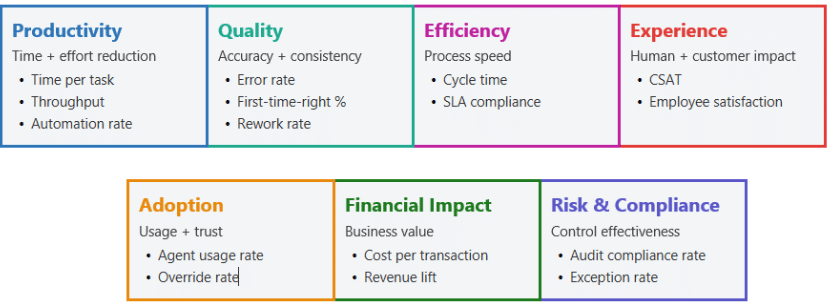
Build value measurement into your Agents. Monitoring these metrics will increase Agent confidence and highlight areas of additional improvement.
The most visible efficiency gains happen in repetitive coordination work. Summarizing meeting notes, updating RAID logs, drafting status reports, preparing sprint updates—these tasks no longer require dedicated PM hours. Month-end close processes that used to consume days of manual reconciliation now run with minimal intervention.
But here’s the important nuance: this doesn’t translate to fewer people. AI drives humans to move up a level. Users stop operating the process and start governing it. That’s a fundamentally different kind of value than simply doing the same work faster.
This is where things get counterintuitive. Top line revenue may initially decline as firms adopt AI-driven efficiencies and shift to fixed price engagement models. Yet EBITDA can increase at the same time. That is not a contradiction. It reflects how value delivery is changing.
Firms are testing the market in a couple of ways:
When agents handle more of the execution work, billing by the hour becomes less viable. That’s a real tension consulting firms are sitting with right now. The old model measured billable hours per consultant. AI-enabled firms are starting to measure project profitability, delivery efficiency, and margin contribution instead. Consultant utilization metrics will gradually give way to earned value management and margin-related metrics, and that shift is already underway.
Traditional utilization tracked one thing: percentage of time billed to clients. That metric made sense when humans did all the execution work. With agents handling more of those tasks, human resources shift toward higher-value activities—making decisions, managing complexity, solving problems, and driving outcomes.
The better question to ask now isn’t “how much of our team is billable?” It’s “are we putting our people on work that actually requires human judgment?” Resource allocation moves from maximizing billable hours to optimizing impact and expertise application. That’s a significant mindset shift for firms that have measured success the same way for decades.
Yes, AI surfaces signals and recommends actions earlier than any static dashboard ever could. Agents monitor dependencies, track progress against baselines, and flag issues before they cascade into larger problems. That’s genuinely valuable.
That said, project success still depends on organizational judgment—not just better data. Experienced PMs still need to interpret conflicting signals, coordinate complex stakeholder dynamics, and make calls when conditions are ambiguous. AI doesn’t eliminate that need. It actually raises the value of those human capabilities, because they’re the parts that were always hardest to automate in the first place.
Here’s something worth saying plainly: the barriers to AI adoption in professional services aren’t technical. They’re operational, cultural, and structural. And that distinction matters a lot.
A firm’s business process maturity will dictate which business processes can actually be automated with AI. That’s not a caveat—it’s the starting point. Good patterns become great with AI behind them. Broken foundations become expensive failures. The gap between the two is significant.
The right sequence matters here:
What makes up a process?
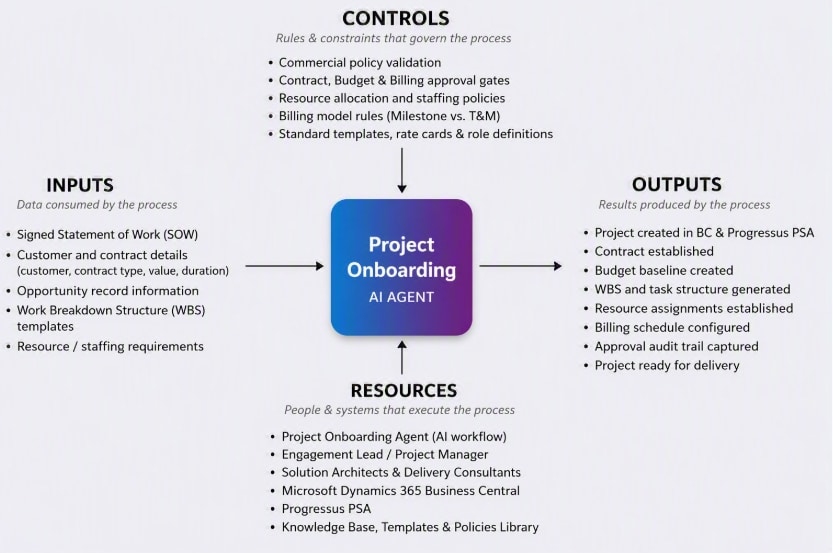
Technology is rarely the first answer. Firms that skip this step don’t just get poor results from AI. They get poor results faster, and at greater cost.
Every autonomous action an AI agent takes needs to be traceable—back to what triggered it and what it changed. That’s not optional. Build for governance from day one, not as an afterthought when something goes wrong.
Autonomous operations only become possible once customer trust has been established. And that trust gets built through orchestrated operations first—where humans review, validate, and approve before AI acts independently. All AI output must be thoroughly reviewed and vetted before anything reaches a client. Deep domain knowledge is what drives customer trust. AI-generated documentation and activities does not replace that.
Here’s a fundamental tension worth understanding. A system of record has to be deterministic, consistent, and auditable. AI agents are probabilistic. That mismatch creates integration challenges that go well beyond connecting APIs.
AI works best in the decision-making layer, with a human in the loop for high-risk and material actions. The quality of AI output is directly tied to what it’s been trained on. Feed an agent your organization’s actual delivery patterns—real project data, real outcomes, real decisions—and the output becomes operationally useful rather than generically correct. That’s the difference between a recommendation a PM trusts and one they quietly override.
Organizations still have to decide what signals mean. They still have to resolve conflicting interpretations and create enough shared understanding for coordinated action. AI handles research, data aggregation, and analysis well. But innovative thinking? That stays human.
This is especially important for consulting firms. If your business is built on expertise in a specific field, original thought can only come from people. When AI generates nearly all of the content or deliverables, traditional domain expertise gets handed off to a machine. That’s a risk worth thinking carefully about before it becomes a client problem.
Identify where automation adds efficiency, but be equally deliberate about identifying where human judgment simply outweighs what AI can do.
The disruptive nature of AI can cause users to stop adopting the new way of work entirely. That’s not a hypothetical—it happens. Push too hard, too fast, and the people you need to make AI work will find ways around it.
The transition has to be gradual, not disruptive. Start with agentic augmentation, where the agent assists humans with decisions, data validation, and content interpretation. Over time, form navigation and data entry get replaced by agents’ autonomous activities and signals. Users move from managing by data entry to managing by exception. That’s a meaningful shift, but it requires measured change management, not overnight reinvention.
Successful implementations share specific patterns. They start conservatively, build controls early, measure deliberately, and train systems on actual operational data. So, what does that look like in practice?
The transition to AI needs to be gradual, not disruptive. Start with agentic augmentation—agents that assist humans with decisions, data validation, and content interpretation rather than replacing human judgment outright.
This means agents suggest rather than execute, at least initially. They surface signals and draft recommendations, but humans review and approve before anything takes effect. Trust gets built incrementally. Organizations move from orchestrated operations to autonomous operations only after the patterns prove reliable. Pushing too hard, too fast is exactly how you lose user adoption entirely.
Every autonomous action needs to be traceable—back to what triggered it and what it changed. The firms that get this right build that audit trail from day one, not as an afterthought six months in.
Governance structures define which actions require human approval and which can run autonomously when specific criteria are met. This matters because agents are probabilistic while systems of record must be deterministic, consistent, and auditable. The governance layer is what bridges that gap. Without it, you’re building on shaky ground.
Before implementation, map end-to-end workflows, handoffs, and decisions. Then track specific outcomes—not general claims about efficiency.
Here are the right questions to ask:
That last question matters as much as the others. Knowing where not to automate is just as important as knowing where to start.
Industry analysis from Gartner predicts that by 2027, organizations will use small, domain-specific AI models three times more than general-purpose ones, precisely because of the need for greater accuracy and business context. A project domain-specific model reads financial and operational project histories and infers health, risk, margin movement, and likely outcomes.
Here is where the real competitive advantage lives. Generic AI produces generic output. The quality of an agent’s output depends heavily on what it is grounded in beyond raw schema. It is trained in historic project telemetry to recognize patterns and trends to infer a project’s current state, trajectory and likely areas of risk.
Firms that feed agents their actual delivery patterns—how projects get staffed, how risks surface, how clients respond—turn technically correct output into something operationally useful. Something a PM would actually trust. Firms will increasingly capture their own business expertise by training their own models and moving away from generic LLMs. That proprietary data is the differentiator.
We are moving from: → Generic AI recommendations → Firm-specific, delivery-grounded insights → Reactive responses to agent output → Proactive governance of agent behavior → One-size-fits-all automation → Maturity-matched implementation
The better starting point is not “Where can we add AI?” It is “Which parts of our operating model are mature enough for AI to support, and where does human judgment still need to lead?”
AI in professional services delivers real value when organizations realize that this is less about technology and more about a transition in how people, workflows and processes operate inside a company. The market data shows genuine commitment: firms are replacing core systems and shifting from hour-based billing to outcome-driven models. The results matter: improved margins, better resource allocation, and higher project success rates.
That said, successful adoption requires measured steps. Start with agentic augmentation rather than full automation, build governance controls from day one, and train models on your proprietary delivery patterns. Generic AI generates generic output; your competitive advantage comes from systems grounded in how your firm actually operates.
Accordingly, the firms winning with AI aren’t the ones deploying fastest. They’re the ones implementing intentionally, with clear metrics and realistic expectations.
How Cloud & AI Enhance Productivity in Professional Services
Talk to us about how Velosio can help you realize business value faster with end-to-end solutions and cloud services.