What is a Supply Chain, Anyway?
Supply chain management is the key to protecting your reputation, profits, and longevity. It builds resilience, agility, and future-readiness.

Table of Contents
Supply chains aren’t new. They’ve been around since humans first began trading goods – evolving from simple localized systems into the complex global networks we rely on today.
But something fundamental has shifted.
Today’s supply chains do more than move products. They determine whether businesses thrive or fail.
As EY noted in a recent report, leading organizations are rethinking their entire supply chains. They’re using advanced technologies to transform reactive, siloed operations into integrated systems that turn uncertainty into opportunity.
That said, modernizing supply chains requires more than a one-time upgrade and a few cycles of incremental improvements.
Per Gartner’s 2025 Future of Supply Chain report, only 29% of orgs are “ready for the future,” despite growing pressure to adapt to rapid change.
In it, analysts emphasize that supply chain leaders must focus on long-term plans, rather than short-term or siloed fixes.
Supply chain transformation is a “forever commitment.” You need to address today’s needs, but ultimately, you’ll need to invest in solutions that offer agility, resilience, and the ability to compete on a whole new level.
With that, let’s first define the supply chain and its key components. Then, we’ll switch gears and explain how supply chains drive performance across the entire business, all through a 2026 lens, of course.
A supply chain is a network of companies, individuals, activities, information, and resources involved in sourcing, producing, and delivering goods from their origin to the final customer.
Well-managed supply chains connect demand and supply across companies, customers, processes, and regions, ensuring the right product arrives at the right place at the right time.
Supply chains consist of two main components: people and processes, which work together to ensure that all materials, goods, and information in the chain move from supplier to customer.
Within any given supply chain, you’ve got a business, its customers, and its suppliers. You’ve also got the suppliers’ suppliers (and their suppliers). Then there are logistics providers, retailers, wholesalers, and others.
There’s also the army of people involved in extracting, producing, and gathering the raw materials needed to make each product, component, or service. Then, you’ve got all the partners, providers, and stakeholders tangentially linked to your supply chain through the contacts in your network.
Each stage of the supply chain represents a distinct function that contributes to the product’s lifecycle. This journey involves extracting raw materials, manufacturing products, and transporting finished goods to consumers.
Supply chains still serve the same purpose they always have. They’re still transforming raw materials into sellable goods and delivering them to consumers.
But how and where that transformation happens is changing.
Similarly, supply chain strategies are evolving in response to a changing tech landscape, challenging economic and geopolitical conditions, and constant disruptions.
Real quick, here’s a look at how supply chains have changed, and what that means for business leaders moving forward.
Traditional supply chains followed a linear sequence, where the output of each step was typically used as the input for the next one.
Fragmented processes meant decisions were based on outdated information. Often, teams relied on slow, manual processes and had limited communication with other “links” in the chain. As a result, responding to real-time change or disruption wasn’t possible.
Traditional models also focused primarily on driving cost savings and efficiency gains within each silo or stage, rather than on more strategic goals.
As an example:
Now, that’s just one scenario. But it’s easy to see how traditional supply chain models become exponentially more vulnerable as supply chain operations – and the conditions around them – grow more complex.
By contrast, modern supply chains are dynamic networks that rely on real-time data, cross-functional collaboration, and embedded intelligence to navigate ever-changing conditions successfully. In other words, they’re agile.
Supply chain agility describes a company’s ability to rapidly sense, respond to, and adapt to change as it’s happening.
This shift toward agility is crucial – largely because today’s supply chains face unprecedented levels of disruption and uncertainty.
In a recent eBook, “How to Build Resilient Supply Chains with Microsoft Dynamics 365,” experts explain that supply chain stability hinges on achieving a “constant state of responsiveness and proactive action.”
Unlike traditional supply chain models, which prioritize cost-savings and efficiency, agile supply chains prioritize resilience, speed, and adaptability.
This means they’re in a better position to:
The point is, today’s supply chains must do more than move goods and keep costs down.
They’re now part of the core business strategy. And, when managed effectively, they’re also a source of adaptive resilience and value creation.
In EY’s How to Reclaim Supply Chain’s Influence as a Driver of Growth report, experts explain how integrating technology across finance, commercial, and supply chain functions unlocks hidden value.
Analysts say aligning and integrating operations across three core areas, finance, commercial, and supply chain, will produce the biggest gains.
To reap those rewards, you’ll need to focus first on unifying all business and supply chain operations in one, connected ecosystem.
Your enterprise supply chain stack might start with solutions like D365 Finance, D365 Supply Chain Management, Power BI, and Copilot.
Then, you may want to add more data sources via Microsoft Fabric, for example, if you have apps, software, or storage that aren’t yet linked to your ERP.
You can then develop purpose-built models to leverage your data, drive decisions, predict outcomes, and gain a deeper understanding of your supply chain – in context with the rest of the business and the outside world.
You’ll also need to set up connected data flows and embedded AI to enable the required end-to-end visibility for supply chain orchestration, automation, and even just basic reporting.
This step paves the way for future process improvements, allowing you to capture insights from your workflows, then use those insights to continue building on that progress.
Of course, there’s more to supply chain modernization than this. But, for now, let’s take a look at how unity and integration unlock value across three key areas:
Inventory management ensures that there’s enough inventory in stock to meet demand and prevents orgs from overstocking, which ties up working capital and increases holding costs.
In a tech-enabled ecosystem, inventory management becomes a strategic driver of performance and profit.
You can optimize inventory with AI-enhanced forecasting and address supply shortages and variability with DDMRP.
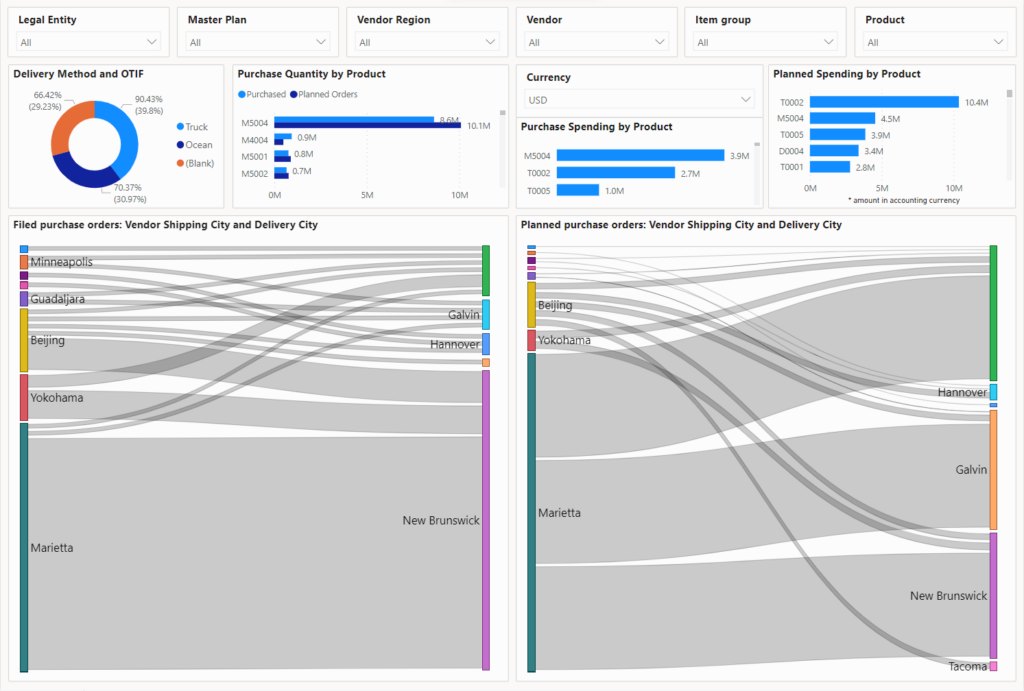
You can also use Power BI embedded reports to analyze supplier performance risks. In this view, you can compare supply flows from past orders against planned supply, and then drill down to view at-risk items by delivery method.
From there, you can identify risks associated with a particular route or delivery method, allowing you to explore alternative routes or sourcing options before orders are delayed.
Real-time data and AI also turn logistics into a strategic advantage. For example, you can monitor shipments, reroute around delays, and even track carbon emissions to support ESG commitments.
You can also incorporate circular economy principles into inventory and manufacturing processes. This might involve tracking materials for reuse, recycling, or remanufacturing — to reduce waste and meet sustainability targets.
Forecasting has evolved from a manual, spreadsheet-driven task into a strategic capability powered by AI and predictive analytics.
According to Gartner, 40% of high-performing supply chain orgs were already using AI supply chain forecasting as of 2024. However, the firm projects that by 2030, approximately 70% of large organizations will adopt AI forecasting.
In its 2025 Digital Trends in Operations survey, PwC reports that over 80% of supply chain orgs use digital dashboards and natural language tools to transform complex forecasting data into clear, actionable insights.
For example, D365 users can explore business process data using Power BI’s visual dashboards to identify hidden demand patterns, predict potential disruptions, and refine their forecasts.
AI-driven forecasting models simulate thousands of “what-if” scenarios, helping teams anticipate uncertainty, optimize schedules, and minimize waste.
You can identify complex patterns, predict demand trends, and uncover hidden risks and opportunities that traditional forecasting methods may overlook.
You can also take proactive action before disruptions occur – creating contingency plans for a range of future outcomes.
AI can also enhance forecasting accuracy. Per McKinsey, early adopters of the firm’s proprietary digital twin technology saw an average improvement of 20-30% in forecasting accuracy. This means your decisions and actions are more likely to yield the desired outcome, giving you greater control over inventory, supply chain processes, and costs.
Supply chain planning (SCP) is no longer siloed or reactive. Instead of trying to predict the future, modern planning aims to make sure you’re ready for any version of the future.
Generative AI can quickly analyze large amounts of historical and real-time data, then use it to run thousands of “what-if” scenarios. Users can plan for potential demand outcomes across a wide range of risk scenarios — natural disasters, cyberattacks, price hikes, supplier disruptions, etc.
Low-code tools and generative AI make supply chain planning more accessible to a broader audience, empowering decision-makers at every level to contribute insights, test scenarios, and drive better outcomes.
Planners can use these tools to make informed decisions in the moment, weighing options before pivoting to Plan B or C. In Power BI, you can align purchasing with real-time demand by visualizing market and operational data through its interactive dashboards.
Analyze demand plans, use integrated AI models to test ‘what-if’ scenarios. In Copilot, you can dig deeper by using natural language prompts to explore your data. For example, “How will next quarter’s demand change if supplier X raises prices by 8%?”
As with forecasting, connected planning empowers everyone in the organization to drive improvements. That way, agility becomes part of the daily routine, rather than a response to crisis.
Ultimately, transforming your supply chain isn’t about implementing specific technologies. It’s about building a more innovative, more connected ecosystem to support your business.
Successful supply chain transformations start with the right strategy, solutions, and, crucially, a partner who knows exactly what it takes to bridge the gap between vision and execution.
That’s where Velosio comes in. As a leading Microsoft partner, Velosio helps clients modernize their supply chains, unlock valuable insights, and optimize every link in the operational chain.
Contact us today to learn more about our supply chain solutions and how they support your transformation journey.
Talk to us about how Velosio can help you realize business value faster with end-to-end solutions and cloud services.