Sustainable Supply Chains: 7 Critical Elements that Unlock Strategic Advantage
Learn how sustainable supply chains drive resilience, compliance, and profitability with essential components supply chain leaders must prioritize.

Table of Contents
For years, businesses viewed corporate sustainability as a PR move. More concerned with virtue signaling than delivering measurable business results.
That perspective has changed. Sustainability is now a core part of supply chain strategy. Gartner calls sustainability a defining characteristic of “durable” supply chains. It’s linked to resilience, risk management, compliance, and long-term performance.
Climate change, resource scarcity, and labor issues have revealed the fragility of traditional supply chains, while stakeholders now demand transparency and proof, not promises.
As regulations tighten, ESG scrutiny intensifies, and operating costs rise, sustainability is essential for achieving operational excellence.
A sustainable supply chain integrates environmental stewardship, social responsibility, and economic viability across every stage of the value chain.
That’s everything from raw material sourcing and manufacturing to logistics and last‑mile delivery. It even extends to product returns, refurbishment, and recycling.
Big picture, this means designing and operating supply chains that reduce environmental impact, protect people, and ensure long‑term economic viability—without sacrificing agility, service levels, or competitiveness.
What separates sustainable supply chains from traditional models isn’t the presence of ESG goals. It’s how deeply those goals are embedded in everyday decisions.
Energy, materials, labor, and even demand itself are becoming more volatile, increasing the cost of inefficiency and over-optimization.
In an environment defined by scarcity, volatility, and ongoing disruption, sustainability is a core performance dimension, alongside cost, service, and risk.
Integrating ESG into sourcing, network design, inventory, and logistics transforms sustainability from a reporting task into a strategic advantage. It enhances resilience, boosts efficiency, and drives long-term growth in a volatile world.
Most sustainability challenges stem from the same underlying issue: fragmented systems and disconnected data.
When environmental, social, and operational information lives in silos, organizations struggle to measure impact, evaluate trade-offs, and scale improvements across facilities, partners, and regions.
Technology provides the foundation for fixing this problem. Modern ERP and SCM platforms unify operational, financial, and ESG data across the extended enterprise.
IoT solutions extend visibility into the physical world by capturing real-time data on assets, energy use, and logistics conditions. Advanced analytics and AI convert raw data into actionable insights. They highlight risks, surface inefficiencies, and enable scenario-based decision-making.
There’s also Microsoft for Sustainability, a suite of tools that helps businesses drive progress toward ESG targets and business growth. It integrates with all the usual MS products, making it easy to connect sustainability to the rest of your org if you’re already in the ecosystem.
Together, these capabilities make sustainability measurable, actionable, and repeatable. The following seven components represent the core building blocks of a sustainable supply chain.
Individually, each addresses a critical sustainability challenge. Together, they form an integrated system that improves ESG performance and boosts long-term profitability, agility, and resilience.
Responsible sourcing, which minimizes environmental impact and ensures fair labor practices, is vital because upstream activities account for most of a supply chain’s footprint.
Visibility is lost in complex, multi-tier networks, creating blind spots in areas like emissions and labor. Systematic approaches are needed for vetting, tracking, and compliance.
Platforms like Dynamics 365, blockchain, and AI-driven risk tools provide visibility and structure to manage compliance, track performance, and flag emerging ESG risks, enabling systemic change across supply networks.
IKEA’s Renewable Energy Program, for example, shows the power of engaging suppliers at scale. By enabling bundled clean‑energy agreements, IKEA increased the number of direct suppliers using 100% renewable electricity from 3 regions in 2021 to 27 regions in 2025, covering 491 suppliers.
According to KPMG, supply chain leaders need a comprehensive understanding of the whole value chain.
They’ll also need a clear picture of the complex regulatory landscape, including ESG regulations, traceability requirements, and due diligence mandates.
This means orgs need to establish a connected data ecosystem that allows them to track materials, products, and emissions from origin to customer.
They’ll also need to look for solutions that identify, capture, and validate partner data on risk mitigation, ESG targets, and human rights.
MS for Sustainability integrates and unifies data from the entire supply chain network and automates data connections and calculations.
Built-in reports ensure data clarity by applying a Microsoft for Sustainability data model to resolve any ambiguity.
Platform capabilities can be easily extended with familiar D365, Azure, and Power Platform tools, allowing you to quickly create custom reports or calculations based on your goals.
You can also extend the platform with Azure IoT Operations to enable auditable compliance workflows and unlock opportunities to use ESG data to improve operational efficiency and optimize supply chain performance.
You might also integrate data sources that support other traceability and compliance requirements.
Microsoft recently launched a Traceability feature in D365 Supply Chain Management. It’s still in preview, but it collects data across the value chain to enforce regulatory compliance and enable auditing.
So, you might decide to combine inventory traceability data with emissions-tracking metrics and other regulatory requirements, and analyze them from one place.
Here’s a screenshot of the Sustainability Manager’s audit history report:
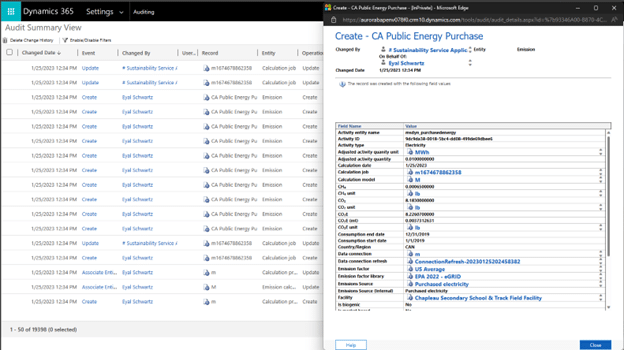
As carbon-reduction targets and environmental reporting become mandatory, organizations need systematic tracking beyond annual averages.
Per the MIT/CSCMP 2025 State of Supply Chain study, top performing orgs are integrating sustainability across all supply chain functions and using it to drive resilience, cost savings, and future readiness.
One key focus area is integrated Scope 3 emissions management. Upstream activities often account for a large share of a company’s footprint, making Scope 3 visibility essential for net-zero goals.
While progress has been made on Scopes 1 and 2, Scope 3 data remains a challenge. Advanced analytics and automation close this gap by standardizing data, improving accuracy, and aligning ESG information with supply chain decisions.
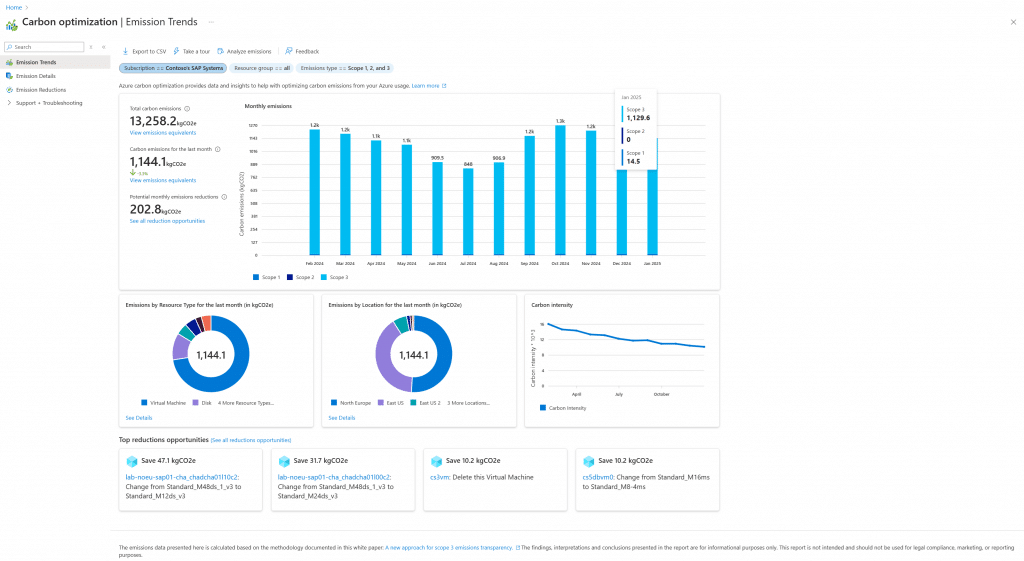
Firms are responding to this challenge by shifting from manual spreadsheets to integrated ecosystems. Microsoft Cloud for Sustainability, for example, calculates granular Scope 1, 2, and 3 emissions for operations and supply chains, enabling a credible reporting,
You can also use Copilot to analyze emissions reports and explore options for improving ESG performance.
If you’re managing fleets, factories, or other industrial equipment, an AI platform like Microsoft Fabric will help you capture insights from physical assets.
Scenario planning tools, such as digital twins, help teams quickly assess trade-offs when considering strategic changes, including air-to-ocean freight, network redesigns, or nearshoring. They can use real-time insights to measure the impact of potential actions on emissions, costs, and service levels.
Data from IoT and connected logistics systems feed these models, enabling teams to track fuel usage and energy consumption to identify efficiency opportunities and emissions hotspots.
You might then enable emissions-optimized, multimodal routing and dynamic carrier selection based on ESG metrics, cost, and reliability.
Circularity impacts several key stages of the supply chain.
It reduces material costs and environmental impact. It creates new revenue streams through refurbished products, secondary markets, and recovered materials. It also helps optimize manufacturing, logistics, and distribution.
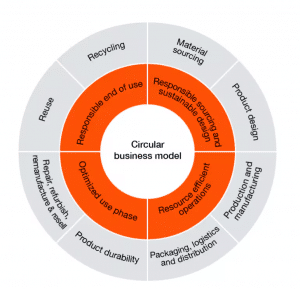
Orgs can capture value from returned goods through refurbishment or component harvesting. They can adopt product‑as‑a‑service models to bring in new revenue. Or – launch repair and upgrade programs that reduce waste and deepen customer loyalty.
But circular strategies require technical capabilities that many traditional supply chains lack. These include:
Technologies like SCM and asset management software, digital twins, and IoT sensors bridge gaps. They standardize maintenance processes, automate workflows, and leverage data to eliminate waste.
Enerjisa Üretim built an end-to-end lifecycle management system using the Asset Management Add‑in for D365 SCM, paired with existing Azure IoT and digital twin solutions.
The company used the updated platform to standardize work permits, safety, and asset processes across all plants. They overhauled their maintenance and operations infrastructure and cut manual processes and paper output by 70%. Employee adoption also surged from a handful of users on the legacy system to nearly all users on D365.
Overall, these changes led to cost savings, improved environmental performance, and greater innovation.
Ethical labor practices focus on ensuring fair working conditions, workplace safety, respect for human rights, and social responsibility across internal operations and extended supply networks.
Violations—whether unsafe working conditions, excessive overtime, or unethical subcontracting—can quickly escalate into real risk. Think legal penalties, supply disruptions, and loss of customer trust.
As regulations and stakeholder expectations increase, organizations are being held accountable not only for their own practices but also for those of their suppliers and partners.
Managing labor and social responsibility at scale requires visibility beyond tier‑1 suppliers. For example, supplier audit management tools can help track labor standards, certifications, corrective actions, and compliance status across global networks.
Workforce analytics provide insight into safety incidents, turnover, training gaps, and working conditions. AI adds a predictive layer by identifying anomalies or emerging risk patterns. That way, you can take proactive action before issues escalate.
Climate volatility, resource scarcity, labor shortages, geopolitical instability, and shifting trade policies are introducing new forms of disruption that can compound quickly.
Risk and resilience concerns are redefining how supply chains are designed and operated.
Supply chain leaders must think in terms of ecosystems, not point solutions. Network design, sourcing, inventory, and logistics decisions must now consider both ESG metrics and traditional KPIs.
New technologies provide the connective tissue for this integration by supplying the data infrastructure, analytics, and automation needed to coordinate complex global operations while advancing sustainability goals. The idea is to incorporate climate and social risks into contingency and dual-sourcing plans.
For example, Nile replaced disconnected legacy systems with Dynamics 365 Finance, Commerce, and Supply Chain Management to integrate end‑to‑end intercompany processes. The company gained scalable growth capacity, improved inventory planning and replenishment, and automated intercompany transactions. This made it easier to handle increased volume without proportional increases in headcount.
To move sustainability from aspiration to execution, clear ownership, KPIs, and governance are essential. Without them, it remains separate from daily operations.
Mandatory sustainability reporting (i.e.: the EU’s CSRD and ISSB) is raising the bar for data quality, consistency, and assurance. However, many organizations still rely on fragmented, manual data, especially for Scope 3, limiting their ability to connect goals to daily decisions.
The next step is building a robust data infrastructure, standardized metrics, and analytics to embed sustainability into operational planning. Integrated dashboards and ESG tools offer a single view of performance across key metrics.
Automated data pipelines and AI-powered predictive insights move leaders from reactive reporting to proactive optimization, linking sustainability directly to business outcomes and spotting risks/opportunities.
For example, SERTECPET uses Power BI to manage its digital transformation, aligning with its mission and reinforcing its commitment to innovation and sustainability through data‑driven decision‑making across its operations.
Sustainable supply chains hinge on interconnected systems.
Technology integrates these components and provides the insights, intelligence, and tools needed to coordinate global supply chain ops and advance sustainability.
Visibility enables measurement, which drives accountability and continuous improvement. Ethical sourcing boosts resilience, and circular design cuts both environmental impact and costs.
Velosio’s supply chain experts can help you unify emissions data, Scope 3 reporting, and ESG performance across your entire network—driving compliance, cost savings, and resilient growth. Get in touch to find out how your sustainability goals translate into measurable supply chain impact.
Talk to us about how Velosio can help you realize business value faster with end-to-end solutions and cloud services.