Professional Services Trends Defining Growth in 2027
Explore the professional services trends shaping 2026, including AI, talent, pricing, connected data, and new approaches to profitable growth.

Table of Contents
At a glance:
The professional services trends shaping 2026 all point to one challenge: growing capacity and margins without simply adding headcount. AI is moving from pilots into daily delivery. In Velosio research, 89% of mid-market professional services firms have bought Microsoft Copilot licenses and 43% already run AI agents in production. Yet only 33% call their data fully AI-ready, and just 28% have CRM fully connected to back-office systems. The firms pulling ahead connect CRM, ERP, and project data first, govern AI with people in the loop, and measure outcomes rather than hours.
Key takeaways
These figures come from the professional services cut of Velosio’s 2026 Mid-Market Technology Report, which includes separate CRM, ERP, and AI Readiness studies.
| Finding | Study |
| 89% have purchased Microsoft Copilot licenses | AI Readiness (n=54) |
| 33% say their data is fully AI-ready | AI Readiness (n=54) |
| 28% have CRM fully connected to back-office systems | Revenue Friction (n=87) |
| 86% say at least 21% of seller time goes to non-selling work | Revenue Friction (n=87) |
| 94% take four or more calendar days to close the month | ERP Modernization (n=36) |
| 56% report significant key-person dependency | ERP Modernization (n=36) |
Source: The Hidden Cost of Delayed ERP Modernization & Revenue Friction to Revenue Flow
Explore the professional services infographic for insights into operating capacity, AI value and CRM adoption.
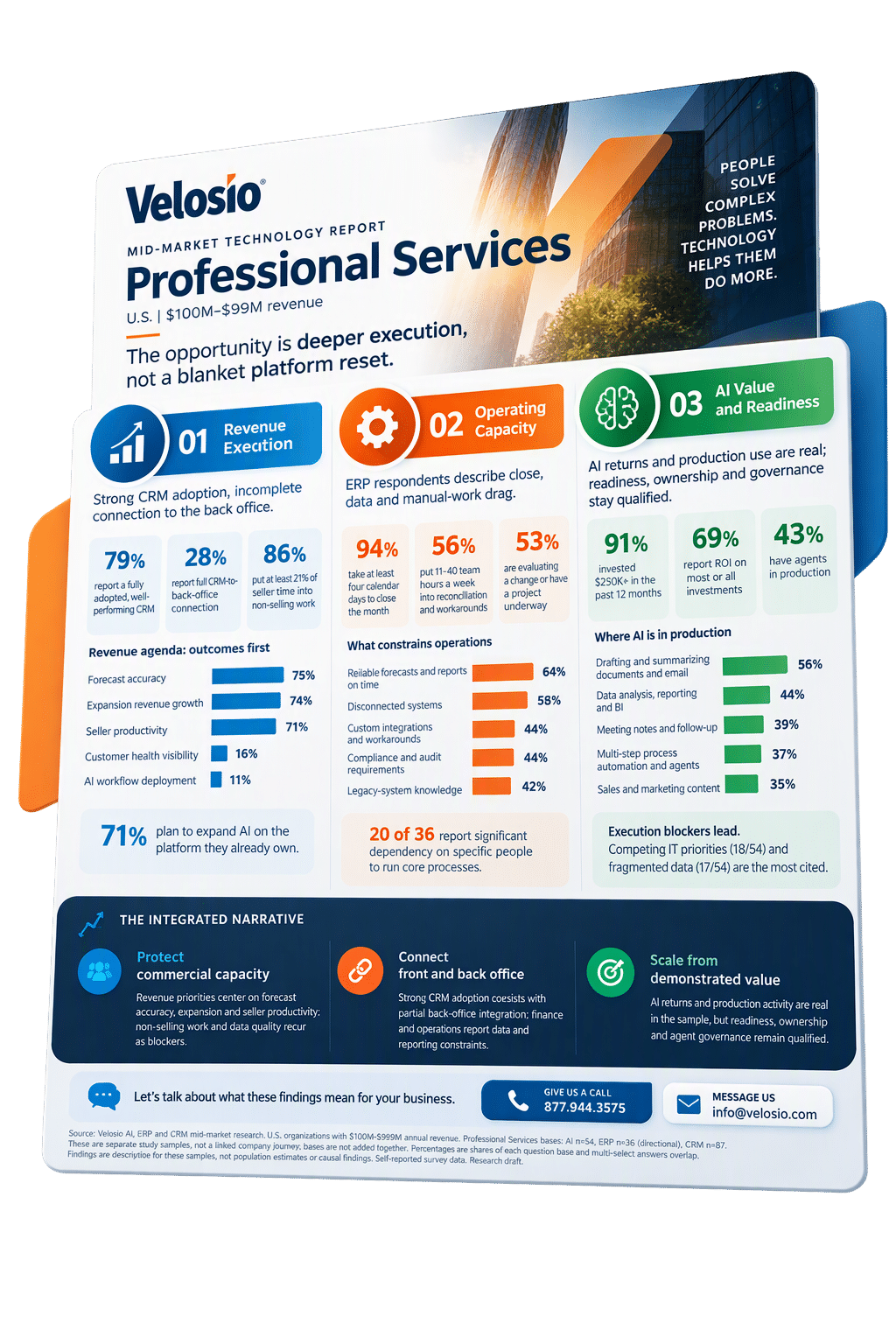
89% have bought Copilot licenses. The edge now is AI built into repeatable delivery work.
Only 33% call their data fully AI-ready. Shared definitions decide whether AI answers can be trusted.
43% run agents in production, but only 46% feel well prepared to govern them.
56% spend 11+ team hours a week reconciling and rebuilding context instead of delivering.
94% take four or more days to close. Leaders need signals early enough to act.
56% cite a growth ceiling. Growth comes from raising the value of each person’s hour.
56% report key-person dependency. Captured know-how cuts risk and gives AI better material.
Fixed-fee and outcome pricing need tight scope, clear acceptance criteria and real-time margin visibility.
79% have a well-adopted CRM, but only 28% connect it to back-office systems.
53% are evaluating or running ERP modernization. Start with the business result, not the platform.
 ®
Three forces are pushing on mid-market firms at the same time: margin pressure, rising client expectations, and fast-moving technology. None of them can be solved alone, which is why the trends below overlap so much.
Growth no longer guarantees healthier economics. Projects are more complex, labor costs keep climbing, and a large share of skilled time goes to work clients never see. In Velosio’s CRM study, 86% of professional services firms say at least 21% of seller time goes to non-selling work such as CRM updates, data entry, follow-ups, and approvals. And 90% say at least 5% of qualified opportunities are lost or significantly delayed by handoff failures between sales, service, and finance.
When margins are under pressure, adding headcount is the expensive answer. Firms need operating leverage: more output from the expertise they already have.
Clients want faster answers, real-time status, and advice tied to their outcomes, not just a list of tasks completed. Firms are responding by putting more weight on the client relationship: 74% of professional services firms in the CRM study rank expansion revenue as a priority, and 75% prioritize forecast accuracy.
James Thomas sees the role of the firm changing with it. As he puts it, “The role of the professional services firm is becoming more critical, not less, as the advisory function outpaces traditional implementation services.” Meeting that expectation depends on connected information. A firm cannot give a client a clear status update if its own project, finance, and resource data disagree.
AI, CRM, ERP, and professional services automation (PSA) systems are becoming dependent on each other. PSA is software for managing projects, resources, time, and billing in one place. A pricing change affects delivery. A talent decision affects which tools you need. AI only works as well as the systems underneath it.
That interdependence is why isolated technology projects often disappoint. In the research, 71% of CRM respondents plan to expand AI or agent capabilities on their current platform, and 53% of ERP respondents are evaluating or already running an ERP modernization project. The firms that benefit most will treat these as one operating model roadmap, not separate purchases.
AI adoption is now table stakes in professional services. The real difference is whether AI becomes part of how the work gets done. Velosio’s AI Readiness study found 89% of professional services firms have purchased Microsoft Copilot licenses, 91% invested $250,000 or more in AI over the past 12 months, and 61% say more than half of their AI pilots have reached full production.
Results are following, though not evenly. 69% report measurable ROI on most or all of their AI investments. The most common production uses are practical: drafting and summarizing (56%) and data analysis and reporting (44%). That pattern matches McKinsey’s State of AI research, which finds that AI use is widespread but enterprise-wide scaling is not, and that the firms seeing the biggest impact redesign workflows rather than adding tools.
Tim Nargassans, Data Analytics Consulting Manager at Velosio, describes the turning point this way:
“AI stopped being an experiment when it became part of the repeatable work rather than a separate pilot or a place I went to ask a question. … The important change was behavioral: people stopped asking whether AI should be used and started expecting it to preserve context, improve the next question, and accelerate the next action.”
Tim Nargassans, Data Analytics Consulting Manager, Velosio
Example: A global IT organization worked with Velosio through a Copilot workshop and moved from exploration to deployment. Teams now use Microsoft 365 Copilot for meeting summaries, document creation, data analysis, and task automation, supported by a dedicated Teams channel for tips and custom Copilot Studio chatbots for HR, technical, and policy questions.
Read how a global IT leader streamlined operations with Microsoft 365 Copilot.
What to do: Pick two or three repeatable workflows, such as proposal drafting or project status reporting, and measure time saved before and after. Production use in a few workflows beats licenses spread thin across many.
AI is only as good as the data it uses, and most firms are not there yet. Only 33% of professional services firms in Velosio’s AI Readiness study say their data is fully AI-ready, meaning clean, unified, governed, and accessible. In the ERP study, 50% say data quality, structure, or accessibility significantly or critically limits AI adoption.
The problem is often not the amount of data. It is the meaning. Tim Nargassans explains:
“The most underestimated problem is not whether the organization has enough data. It is whether the organization has made the meaning of that data explicit enough for people and AI to use consistently. … You don’t want AI to guess; you want it to know.”
Tim Nargassans, Data Analytics Consulting Manager, Velosio
Take a common example. Two teams calculate utilization or margin from the same data and get different answers because they use different definitions, filters, or timing rules. Every system may be working correctly, and the business still has no single trusted number. Put AI on top of that, and it returns the confusion faster.
James Thomas puts the principle simply: “You cannot automate a process that is broken or one that you don’t understand. AI will amplify what exists.” MIT Sloan Management Review makes the same point: the right data and the right people can make or break an AI deployment.
Tim Nargassans and Carolyn Norton explain why trusted data has to come before AI.
AI agents are moving beyond chat into real business processes. An AI agent is software that can monitor a situation, take a series of steps toward a goal, and hand decisions to a person when needed. In Velosio’s research, 43% of professional services firms already have agents in production in at least one workflow, but only 46% feel well prepared to govern them and only 33% have an executive sponsor who owns AI outcomes across functions.
That gap between use and governance is the risk to watch. James Thomas frames the opportunity this way:
“The competitive edge won’t come from using AI. It’ll come from knowing what to delegate to agents and what should always stay human.”
James Thomas, Industry Specialist, Velosio
Today’s business applications assume a person is operating them: selecting from menus, reading screens, filling in forms. An agent-driven process flips that. The agent does the routine steps, and the person reviews exceptions and approves material decisions. James recommends a gradual path: start with augmentation, where agents assist people with data validation and drafting, then move to orchestration across steps, and only then to autonomous work once trust is earned.
Velosio applies this to project onboarding. When a deal closes, an agent drafts the contract lines, project tasks, and budget, grounded in how the firm actually delivers. It flags sections that need human review, such as an over-allocated resource, and the project manager approves before anything is written to the ERP.
See how an agent sets up a new project from a closed deal, with the project manager approving each material step.
Agents validate data and draft content. People do the work and review every output.
Agent ran alongside the team for a full cycle
Output matches the team’s work
A named owner for the workflow
Agents run multi-step processes and flag exceptions. People approve material steps before anything is written.
Every action traceable to its trigger and its change
Approval controls and guardrails in place
Executive sponsor owns AI outcomes
Agents act on their own in bounded workflows. People handle exceptions and review outcomes.
AI · n=54
®Governance needs to be designed in from day one. Microsoft Research on human oversight of agentic systems identifies four forms of oversight: control before an agent acts, planning together, real-time monitoring, and review after the action. James adds a practical rule: “Every autonomous action needs to be traceable back to what triggered it and what it changed.”
What to do: Start with one bounded workflow that has clear rules, a clear owner, and a measurable result, such as reconciliation or status report drafting. Run the agent alongside your team for a full cycle and compare its work to theirs before you let it act on its own.
Administrative work is quietly eating into professional services margins. In Velosio’s ERP study, 56% of firms say their finance or operations team spends 11 or more hours a week on manual reconciliation, spreadsheet maintenance, or workarounds. 81% spent one to three weeks or more of extra effort in the past year on audit prep, regulatory reporting, or insurance reviews because data or controls were not readily available.
Tim Nargassans names the cost most leaders miss:
“The hidden cost I see most often is reconstruction: highly skilled people repeatedly rebuilding context the organization already possesses. … In professional services, five minutes here and 30 minutes there eventually become thousands of expensive hours spent rediscovering rather than delivering.”
Tim Nargassans, Data Analytics Consulting Manager, Velosio
Reconstruction looks like searching old emails before a client call, rebuilding a status report by hand, or spending hours figuring out what a departed colleague knew. None of it looks significant on its own, so it rarely shows up as a problem. Added up across a firm, it competes directly with billable time.
Example: A professional services client lost a key person and could not document an end-to-end business process. Using the client’s existing SharePoint content and Copilot, our team produced about a dozen process visuals in roughly four hours. The client had spent weeks trying to do the same thing.
Case study: J.G. Management Systems, a government contracting and consulting firm, moved from Microsoft Dynamics SL to Dynamics 365 Business Central with Progressus project accounting. The change streamlined project setup, invoicing, timesheets, and approvals, and the firm reported an 83% reduction in the time it takes to enter a new project. About 100 employees now submit weekly timesheets in the same system.
Read how JG Management Systems found efficiencies in the cloud.
Velosio sees the same pattern in its own operations. We built a support timesheet agent that automates allocation and billing on time logged by support engineers, a small process fix that adds up across hundreds of entries. TSIA’s Professional Services 2.0 playbook connects this kind of work directly to utilization, margins, and operating model redesign.
What to do: Ask each practice lead to estimate weekly hours spent rebuilding context, reconciling numbers, and preparing reports. That number is your baseline for every automation decision that follows.
Month-end reporting is too slow for the decisions professional services leaders need to make. In Velosio’s ERP study, 94% of professional services firms take four or more calendar days to close the month, and 94% say high-stakes decisions such as pricing, hiring, or capital allocation are delayed at least occasionally because data is unavailable, inconsistent, or assembled by hand. 64% struggled to produce reliable forecasts and reports on time.
Tim Nargassans describes a pattern he has seen in practice reviews: forecast hours and actual billed hours diverge, and the first leadership question is “Why did this happen?” By the time the team rebuilds the answer from project details and staffing assumptions, the capacity or revenue opportunity is gone.
“Reporting tells you what happened. Better analytics explains why. Real operational value comes when the information arrives early enough to change what happens next.”
Tim Nargassans, Data Analytics Consulting Manager, Velosio
Case study: A management consulting firm came to Velosio running an aging ERP, a separate CRM, sticky notes, and spreadsheets. It had little visibility into its consulting bench after a deal closed, so resourcing scrambled to staff new statements of work. Timesheets were collected monthly, so a project could run over budget for weeks before anyone knew. The firm moved to Dynamics 365 Business Central, Customer Engagement, and Progressus, with Power BI giving executives real-time visibility. Leaders can now see which opportunities are likely to close and plan the resources to deliver them.
Read how a management consulting firm nailed project management.
Example from our own delivery: Project status can look green while the client is losing confidence. At Velosio, we built an AI risk-scoring tool that combines traditional project metrics with sentiment from emails, meeting transcripts, documents, and short stakeholder surveys. It produces a single composite risk score, weighted so an executive sponsor’s view counts more than an end user’s. To get consistent responses, we built the surveys into our statements of work. Our project managers now see problems forming before they show up in budget or schedule variance.
MIT CISR research on real-time decision-making argues the same point from a different angle: companies that run on yesterday’s data lose ground to those that act on current information.
What to do: Set up exception-based alerts for three numbers: forecast vs. actual hours by project, utilization by practice, and backlog against capacity. Leaders should not have to hunt for the problem.
Hiring at the same rate as revenue is no longer a reliable growth plan. Specialized talent is scarce, labor is expensive, and onboarding takes time. Firms are looking for ways to scale expertise instead: 56% of ERP respondents cite a growth ceiling, and 31% name scaling without proportional headcount as a priority.
“The goal is not to replace expertise. It is to stop wasting expertise. When growth cannot come from adding more people, it has to come from increasing the value of a person’s hour.”
Tim Nargassans, Data Analytics Consulting Manager, Velosio
The metrics change with the strategy. Revenue per employee, margin per employee, and time returned to client work matter more than raw headcount. Tim describes the choice every firm faces: use AI to do the same work with less effort, or keep the same effort and deliver much more value.
Example: A financial services client ran an underwriting process that could take about 90 days. We built an automated platform connecting 12 systems across lead management, CPQ, contracting, and underwriting. On launch day, about 40% of deals passed underwriting in under 30 seconds, so revenue started sooner and trained staff could focus on cases that needed judgment.
McKinsey Global Institute makes the case that leaders need to redesign work around partnerships between people and agents, not automate isolated tasks.
What to do: List the five tasks your senior people do most often that do not need their judgment. Those are your first candidates for automation or delegation.
The most valuable people in professional services are shifting from knowing the answer to knowing how to get to a better one. Knowledge risk is high: 56% of professional services firms in Velosio’s ERP study report significant key-person dependency, meaning roles whose departure would cause significant disruption. 42% struggle to onboard or keep staff who understand their legacy systems.
James Thomas is clear on what AI does to roles like project management:
“AI does not replace the project manager. It removes the repetitive work that stops PMs from doing their real job: leading people, solving problems, managing complexity, making decisions, and driving outcomes.”
James Thomas, Industry Specialist, Velosio
Tim Nargassans sees the bar rising for top performers. Technical depth still matters, but breadth, business fluency, and judgment matter more. “The future top performer will not compete with AI,” he says. “They will compound their expertise through it.”
This shift also makes captured knowledge a strategic asset. When a firm documents how it delivers, it reduces key-person risk and gives AI better material to work from. The World Economic Forum Future of Jobs Report 2025 lists AI and big data, along with technological literacy, among the fastest-growing skills through 2030.
What to do: Identify your top five key-person risks. For each one, record how that person handles their most important process, and store it where your team and your AI tools can find it.
AI is weakening the link between hours worked and value delivered. When AI makes delivery faster, billing by the hour can mean earning less for better work. Firms are testing fixed-fee, subscription, retainer, and outcome-based models, often combined.
James Thomas expects the scorecard to change: “Consultant utilization metrics will gradually give way to earned value management and margin-related metrics.” He notes that in some cases top-line revenue may dip at first while EBITDA improves, as AI efficiencies and fixed-price work take hold. Earned value management (EVM) measures progress by the value of work completed, not hours spent.
Tim Nargassans warns that the operating model has to change before the pricing model can:
“Uncertainty that is hidden during sales does not disappear when the contract becomes fixed fee; it simply becomes delivery risk. … Time is an input. The client is buying an outcome.”
Tim Nargassans, Data Analytics Consulting Manager, Velosio
Outcome-based work needs bounded outcomes, named owners, measurable acceptance criteria, documented exclusions, and disciplined change control. It also needs real-time margin visibility, so you know early when a fixed-fee engagement is drifting. TSIA describes the same shift toward measurable outcomes and scalable delivery.
Clients notice the difference. When IMS Legal Strategies, a litigation consulting firm, chose a partner to move its paper-based mock trial process to Power Apps, Power BI, and Power Pages, the team picked Velosio because the proposal had one all-in cost, a specified solution and deliverables, and named people doing the work.
Read how IMS created a better client experience with Power Platform.
What to do: Choose one repeatable engagement type and price it as a fixed fee with written acceptance criteria. Track margin weekly against the estimate to learn where your scoping needs to tighten.
CRM adoption alone does not give a firm one connected view of the business. Velosio’s CRM study shows the gap clearly: 79% of professional services firms have a fully adopted, well-performing CRM, compared with 38% in other industries. But only 28% have that CRM fully connected to back-office systems. In the ERP study, 58% struggled to manage data across disconnected systems.
CRM · n=151
ERP · n=36
®“The most damaging disconnect is that every system can contain a different version of the business. … A fragmented enterprise does not become unified simply because an LLM sits on top of it.”
Tim Nargassans, Data Analytics Consulting Manager, Velosio
CRM knows the opportunity. ERP knows what was invoiced. The project system knows delivery. Resource planning knows capacity. When those systems disagree, sales and finance report different revenue totals from the same warehouse, and nobody trusts the forecast. Connecting them around a client-to-cash model (pipeline, delivery, billing, expansion, and retention) gives every team the same picture. The management consulting firm in Trend 5 is a good example: connecting CRM, ERP, and project accounting is what gave its resourcing team an early view of incoming work.
James Thomas adds that connection is only the start. “Even in today’s integrated environment, business applications assume a human operator,” he says. Once systems share data, agents can begin to act across them. The Forrester Total Economic Impact study of Dynamics 365 partners covers how integrated CRM, ERP, and AI ecosystems support that shift.
What to do: Pick one number that sales and finance currently report differently, such as booked revenue or backlog. Agree on one definition and one source, and use it as the pilot for connecting your systems.
Modernization is active across professional services, but the goal is changing from replacing old systems to improving how the business runs. 53% of ERP respondents are evaluating or already running an ERP modernization, and 64% say ROI evidence would raise the urgency. Firms most want outside help with data foundations (39%) and core system integration (37%).
“Implementation asks, did we deploy it? Modernization asks, what changed for the business because we did?”
Tim Nargassans, Data Analytics Consulting Manager, Velosio
Successful programs start with the business decision and work back to the technology. They define who owns the data, how success will be measured, and what comes after go-live. James Thomas recommends starting with a full view of the process: “Map end-to-end workflows, handoffs, and decisions,” then decide where automation helps and where human judgment matters more.
Case study: Kidder Mathews, a commercial real estate firm on the West Coast, had run Microsoft Dynamics SL on premises for more than 20 years. With about 35,000 transactions a month across brokerage, property management, valuation, and other revenue streams, the old system had become slow and manual. Velosio moved the firm to Dynamics 365 Business Central with Progressus, Power BI, and Microsoft 365. During implementation, our team documented existing processes and mapped them to new ones, then used that work to build user guides and a train-the-trainer program.
Read how Kidder Mathews capitalized on productivity solutions.
McKinsey Global Institute’s research on the real AI advantage reaches a similar conclusion: the advantage comes from redesigning work and operating models, not from doing the same work slightly faster.
What to do: Before you select any platform, write down three business results the project must change and how you will measure each one. Use that list to judge every scope decision.
The firms that act on these trends follow a deliberate order. Each step makes the next one easier and less risky.
Map client-to-cash workflows, find decision bottlenecks and count hours lost to reconstruction.
Link CRM, ERP, project and analytics systems so sales, delivery and finance share one view.
Assign data owners, write shared definitions, set quality standards and approval controls.
Start AI with forecasting, capacity planning, project reporting and drafting, where results are measurable.
Track productivity, project margin, forecast accuracy, delivery speed and client outcomes.
Add AI assistance, then expand to autonomous workflows only as trust grows.
®These trends do not call for more technology for its own sake. They call for a clear plan: connect your people, data, and systems, build visibility before automation, put AI on a trusted foundation, and measure what changes for the business.
The firms that do this deliberately will grow capacity and protect margins in 2026 and beyond.
Velosio is a project-based business too, so we use these practices in our own delivery before we recommend them to clients.
The most important professional services trends in 2026 are AI moving from pilots into daily delivery, data readiness becoming a competitive advantage, agentic workflows, the margin cost of administrative work, demand for real-time visibility, growth without matching headcount, evolving talent models, value-based pricing, CRM, ERP, and AI convergence, and outcome-focused modernization.
AI is compressing research, drafting, reporting, meeting follow-up, and analysis, so work that took days can take hours. In Velosio research, 89% of mid-market professional services firms have purchased Copilot licenses and 43% run AI agents in production. The bigger shift is operational: firms are redesigning workflows, pricing, and roles around faster delivery.
AI is more likely to change professional services jobs than replace them. It takes on repetitive work such as status reports, meeting summaries, and data entry, while people keep ownership of judgment, client relationships, and decisions. The competitive edge comes from knowing what to delegate to AI agents and what should always stay human.
Connected data gives sales, delivery, and finance one trusted view of pipeline, capacity, margins, and cash. Without it, teams reconcile spreadsheets and decisions stall. In Velosio research, 94% of professional services firms report data-related decision delays. Clearly defined, connected data also makes AI dependable, because AI amplifies whatever foundation it is given.
Start with the business problem, not the platform. Map client-to-cash workflows, find where data breaks between CRM, ERP, and project systems, and fix those foundations first. Then apply AI to measurable use cases such as forecasting, capacity planning, and reporting. In most firms, connecting core systems comes before scaling AI or autonomous agents.
Most firms are not fully ready, and that is normal. Only 33% of professional services firms in Velosio research say their data is fully AI-ready. You do not need perfect data everywhere to start. Pick one workflow with trusted data and a clear owner, prove value there, and expand your data foundation step by step.
Statistics in this article come from the professional services cut of Velosio’s 2026 Mid-Market Technology Report, which includes three studies of mid-market organizations: a CRM study (n=87 professional services respondents), an ERP study (n=36), and an AI Readiness study (n=54). With samples of this size, small differences between figures should be read with care.
Talk to us about how Velosio can help you realize business value faster with end-to-end solutions and cloud services.