Why AI-Powered ERP is Now a Strategic Imperative for Modern Enterprises
Why investing in an AI-powered ERP system will be table stakes in the coming decade.

Table of Contents
Operational efficiency is a boardroom buzzword that generally refers to things like incremental improvements to processes, marginal gains in productivity, and steady maturation of digital capabilities. But the conditions shaping today’s business landscape have outpaced incrementalism. Volatility is no longer episodic—it is the baseline of business existence. Tariffs, geopolitical shifts, supply chain fragility, inflationary pressure, and talent scarcity have converged to create an operating environment where traditional methods simply cannot keep up.
At the same time, AI has advanced from a promising tool to a transformational force. This is not about meeting summaries, automated workflows, or digitized reports. It is about rearchitecting the core of the enterprise—how we plan, decide, govern, operate, and adapt.
Most organizations today are under immense operational strain. Data shared by Microsoft underscores the challenge:
These figures point to a deeper truth: complexity is outgrowing human‑centered workflows. The traditional model—teams coordinating across spreadsheets, systems, and manual judgment—cannot scale in an era that demands real‑time insights, proactive action, and operational resilience.
Enterprises that continue relying on legacy ERP processes are not just inefficient—they’re exposed.
To succeed in the next decade, finance organizations must evolve beyond process optimization and toward intelligent orchestration.
Microsoft envisions what they call the Frontier Organization—a fundamentally new operating model where humans and AI agents work together as hybrid teams.
This is not theoretical. It’s already in motion.
Frontier Organizations are defined by:
In this model, AI is not an assistant. It is an extension of the enterprise.
It monitors. It reasons. It acts.
And critically—it learns.
This shift represents a generational opportunity for enterprise leaders willing to rethink how value is created.
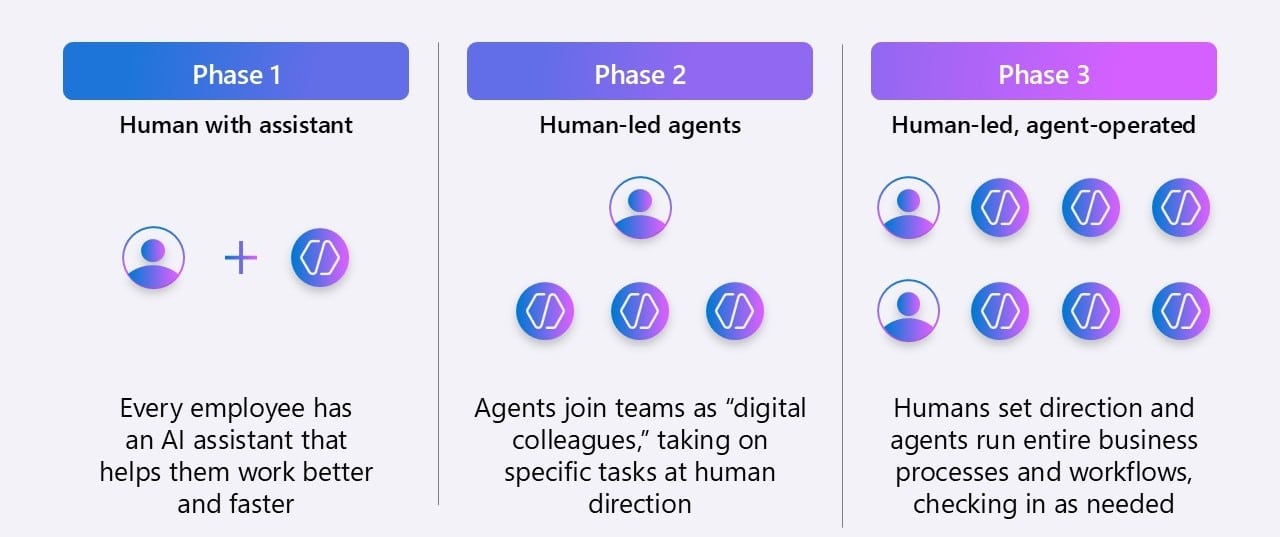
As organizations grow with AI, their use cases change. Microsoft maps out three phases of AI maturity:
Phase 1: Human With Assistant
AI enhances individual productivity—summarizing, retrieving, and contextualizing information. This is a very basic usage of AI in daily tasks, often initiated by the human.
Phase 2: Human‑Led Agents
AI agents execute end‑to‑end tasks under human oversight: reconciling ledgers, managing collections queues, monitoring supplier communications, and more. This is the beginning of regular automation.
Phase 3: Human‑Led, Agent‑Operated
AI agents orchestrate entire business processes autonomously—running financial close cycles, managing compliance workflows, or driving continuous planning.
Most enterprise organizations sit between phases 1 and 2. The competitive leaders of this decade will be those who intentionally and aggressively move toward phase 3.
To translate AI from a technological milestone to an enterprise advantage, leaders must reframe how their organizations operate.
AI eliminates repetitive work so teams can focus on strategic analysis, relationship management, and forward‑looking decision support.
This isn’t just productivity—it’s talent strategy.
Successful enterprise organizations rely on precision, timeliness, and trust. AI‑driven engagement enables:
AI makes it possible to redesign processes that were previously constrained by human limitations—close cycles, reconciliations, forecasting, collections, and compliance.
These processes become not only faster but fundamentally smarter.
AI compresses planning cycles, enhances forecasting accuracy, and unlocks continuous insight. Leaders gain transparency into performance, risk, and opportunity at a tempo unmatched by manual operations.
In short:
AI does not just make finance better.
It changes what finance is capable of.
Here are concrete areas where organizations are already seeing transformative results.
Agents continuously reconcile sub‑ledger and general ledger data, reducing close cycles from days to hours.
This shift frees teams for analysis, not mechanics.
Agents execute end‑to‑end research, scenario modeling, and data synthesis.
Organizations have already achieved:
AI‑driven collections agents prioritize accounts, send autonomous reminders, flag anomalies, and execute resolution workflows—accelerating liquidity and reducing risk.
Agents continuously monitor transactions, identify anomalies, prepare audit evidence, and synthesize regulatory guidance.
For enterprises facing global compliance burdens, this is game‑changing.
These are not pilots. They are production outcomes.
Microsoft has positioned Dynamics 365 as a next‑generation ERP designed for the era of autonomous operations.
Executives should note three differentiators:
Including account reconciliation, supplier communication, collections, payments, time/expense, project activity, financial research, and more.
Dynamics 365, Dataverse, Power BI, and the Microsoft Graph unify operational, financial, and productivity data—giving agents the context they need to act intelligently.
With Copilot Studio and 1,600+ connectors, organizations can extend agentic capabilities across:
This is not a closed ecosystem. It is a composable strategy.
Organizations are that are already using AI illustrate the scale of transformation already underway.
Lifetime Products integrated a Supplier Communications agent, which proactively mitigates order delays and supply chain disruptions.
The team at US AutoForce uses AI in Excel to find discrepancies, suggest matches, and automate tasks, cutting errors and saving hours each month. This allows finance professionals to spend more time on strategic analysis and decisions.
Microsoft’s own finance organization leverages AI in its financial operations across multiple processes, eliminating manual work, data silos, and accuracy errors related to scaling operations.
At Velosio, our VP of Finance trained an agent to generate our monthly executive summary automatically, which typically contains more than 65 pages of data.
These results aren’t marginal—they are tectonic.
AI adoption is no longer a technical initiative. It is an enterprise leadership mandate.
Executive teams should ask:
This is the moment to lead, not observe.
AI‑powered ERP represents a paradigm shift in how enterprises create value.
Leaders who embrace this shift will build organizations that:
The future enterprise will not be defined by its size, but by its intelligence.
AI agents are not replacing teams. They are expanding what teams can achieve.
And the organizations that adopt agentic finance and operations today will define the competitive landscape tomorrow. Contact Velosio today to speak to one of our experts about how data and AI can help your current ERP system.
Talk to us about how Velosio can help you realize business value faster with end-to-end solutions and cloud services.